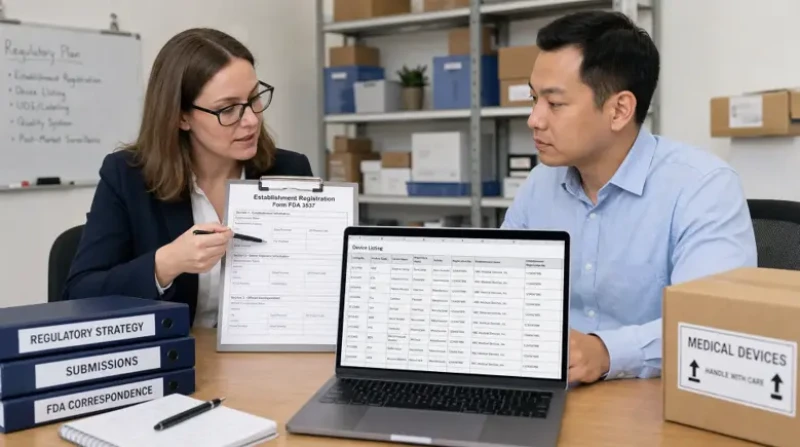
FDA registration identifies the medical device establishment, while FDA device listing identifies the medical devices associated with that establishment. Registration is establishment-focused. Listing is device-focused. Both can be required for U.S. medical device market access, but neither registration nor listing means FDA approval, 510(k) clearance, De Novo grant or PMA approval.
For US medical device manufacturers, the key distinction is simple: FDA Registration = Establishment and FDA Device Listing = Device. The two requirements often sit in the same FDA device registration and listing workflow, which is why they are frequently confused.
Ready to Streamline Your Regulatory Compliance?
Join hundreds of companies who trust OMC Medical for their regulatory needs. Get expert guidance and ensure compliance across all markets.
Call Now +44 208 066 7260What Is FDA Medical Device Registration?
FDA medical device registration, often called establishment registration, is the process of identifying a medical device establishment to the U.S. Food and Drug Administration. The registration is tied to the business location and its regulated activities, not to a specific device.
FDA explains its requirements for medical device establishment registration and listing on its official Device Registration and Listing page. The legal framework is found mainly in 21 CFR Part 807.
A medical device manufacturer may need to register when it manufactures, prepares, propagates, compounds, assembles or processes a medical device intended for U.S. commercial distribution. Other establishment types can also have obligations, depending on their role. Examples include specification developers, repackagers, relabelers, remanufacturers, contract sterilizers, foreign manufacturers and initial importers.
Registration generally includes establishment details such as the legal business name, physical address, contact information, owner/operator information and establishment activity type. For applicable establishments, registration must be renewed annually. FDA also requires payment of the annual medical device establishment registration user fee where applicable, with the current fee published by FDA for each fiscal year.
Registration helps FDA identify who is involved in the U.S. medical device supply chain, communicate with establishments and support compliance oversight.
What Is FDA Device Listing?
FDA device listing is the process of identifying the medical devices associated with a registered establishment. If registration tells FDA “who and where,” device listing tells FDA “what devices are being placed into U.S. commercial distribution.”
A device listing FDA record may include information such as the device name, proprietary name, device classification, product code, establishment activities and applicable premarket submission information where required. The exact information depends on the device and the establishment’s role.
Device listing is linked to the registered establishment. For example, a manufacturer may register its establishment and then list the devices it manufactures for U.S. distribution. In some cases, a specification developer, contract manufacturer or relabeler may have different obligations based on its specific activity.
Listing is important because it connects products to the parties responsible for regulated activities. It also helps FDA monitor the types of devices being marketed in the United States. However, listing a device is not the same as obtaining clearance or approval. If a device requires 510(k), De Novo or PMA authorization, listing does not replace that requirement.
FDA Registration vs Device Listing: What Is the Difference?
FDA registration is about the establishment. FDA device listing is about the device. The combined workflow is sometimes described by companies as FDA device registration listing, but the two submissions answer different regulatory questions.
In practical terms, an FDA registered establishment may have one or more device listings associated with it. The registration number identifies the establishment. The listing information identifies the device or devices connected to that establishment’s regulated activity.
Does FDA Registration or Device Listing Mean FDA Approval?
No. FDA registration or listing does not by itself mean that FDA has reviewed or approved the device’s safety and effectiveness.
This distinction is critical for marketing, labeling, distributor communications and investor materials. A company should not describe a device as “FDA approved” simply because the establishment is registered or the product appears in the FDA registration and listing database.
These are separate concepts:
If you need a deeper explanation of premarket outcomes, OMC Medical’s article on FDA cleared vs approved vs granted explains how 510(k), De Novo and PMA differ. This article focuses on registration and listing, which are administrative and compliance obligations tied to establishments and devices.
Who Needs FDA Medical Device Registration and Listing?
FDA medical device registration and listing obligations depend on the company’s role, location and regulated activities. Not every business touching a device has identical obligations.
Common establishment roles that may trigger FDA device registration or listing obligations include manufacturers, contract manufacturers, specification developers, repackagers, relabelers, remanufacturers, contract sterilizers, foreign manufacturers and initial importers. The exact requirement must be assessed against FDA rules and the device’s commercial distribution model.
For example, a U.S. manufacturer placing its own finished device into commercial distribution may have both registration and listing obligations. An initial importer may have registration duties, but its device listing obligations may differ from those of the foreign manufacturer. A distributor that only distributes a finished device without further processing may not have the same obligations as a manufacturer or relabeler.
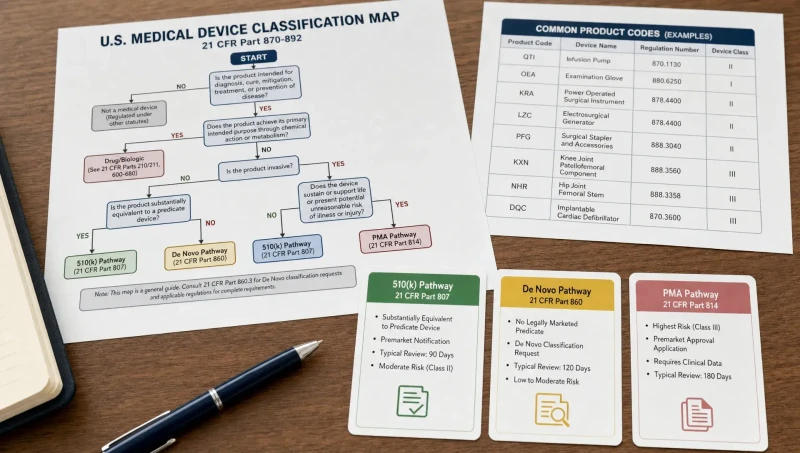
Device classification also matters because it affects broader U.S. market access requirements. If you are still confirming whether your product is Class I, II or III, OMC Medical’s guide to FDA medical device classification explains how risk class influences regulatory expectations.
What Information Is Needed for FDA Registration and Device Listing?
Manufacturers should prepare core establishment and device information before starting the FDA device registration and listing process. The required data can vary, so this should be treated as a planning guide rather than an exhaustive checklist.
Typical information categories include:
● Establishment details, such as legal name, physical address and contact information
● Owner/operator and official correspondent information
● Establishment type and regulated activities
● Manufacturer or specification developer details, where applicable
● Device name, proprietary name, product code and classification information
● Applicable premarket submission information, where required
● U.S. Agent information for applicable foreign establishments
The quality of this information matters. Incorrect establishment activities, product codes or premarket submission references can create downstream compliance problems, including confusion during importation, FDA review of records or inspection preparation.
How Does FDA Registration and FDA Device Listing Work?
The FDA device registration and listing process is practical, but it should be completed only after the manufacturer understands its device classification, establishment role and applicable premarket requirements.
Determine whether registration is required: Assess whether the establishment’s role and activities fall within FDA medical device registration requirements.
Identify the establishment type and regulatory obligations: Confirm whether the company is acting as a manufacturer, specification developer, initial importer, relabeler, repackager, contract sterilizer or another regulated establishment type.
Determine the device’s applicable FDA requirements: Confirm classification, product code, exemptions and whether a 510(k), De Novo or PMA is required before marketing.
Complete establishment registration: Submit the establishment information through FDA’s electronic registration system and pay the applicable user fee where required.
List applicable devices: Associate the relevant devices with the registered establishment and provide device-specific information.
Submit required information and fees, where applicable: Ensure the registration, listing and fee steps align with current FDA instructions.
Maintain and update registration/listing information: Renew registration annually where required and update listing information when relevant changes occur.
Manufacturers should not start commercial distribution based only on registration and listing if the device still requires premarket authorization. For a broader market entry sequence, OMC Medical’s guide on steps to register a medical device in the USA outlines how classification, submissions, labeling and post-market duties fit together.
FDA Registration and Listing for Foreign Medical Device Manufacturers
Foreign medical device establishments that manufacture devices imported or offered for import into the United States may have FDA registration and device listing obligations. These requirements depend on the establishment’s role and the device’s U.S. distribution pathway.
Applicable foreign establishments generally must designate a U.S. Agent. The U.S. Agent acts as FDA’s communication point for the foreign establishment and may assist FDA in communications or inspection scheduling. The U.S. Agent role should not be confused with the manufacturer’s regulatory responsibilities.
The foreign manufacturer remains responsible for meeting applicable FDA requirements, including correct classification, premarket authorization where required, labeling compliance, Quality System requirements and post-market obligations. A U.S. Agent supports communication with FDA, but does not automatically become the legal manufacturer or initial importer.
Foreign manufacturers should also make sure their listing information is consistent with import documentation and U.S. commercial arrangements. Inconsistent names, addresses, product codes or establishment roles can create avoidable delays at the border or during compliance checks.
How to Check FDA Device Registration and Listing
Manufacturers, importers, distributors and purchasers can search FDA’s public registration and listing information using the agency’s Registration and Listing database. This FDA database can help users research establishments and listed devices.
A database entry may show establishment registration information, owner/operator details and device listing information that FDA makes publicly available. It can be useful for verifying whether a company appears as a registered establishment and whether certain devices are listed.
A public record cannot prove every compliance point. In particular, a US FDA medical device listing entry should not automatically be interpreted as proof that the device is FDA cleared, De Novo granted or PMA approved. Premarket authorization should be checked separately through FDA’s relevant 510(k), De Novo or PMA databases when applicable.
Database searches can also be affected by company names, ownership changes, spelling, subsidiaries and listing updates. If information does not appear as expected, manufacturers should review their official records before assuming there is no registration or listing.
Common FDA Registration and Listing Mistakes
Many compliance problems come from treating registration and listing as a simple administrative task. The process is administrative in form, but the information must reflect the company’s actual regulatory position.
Common mistakes include:
● Assuming establishment registration equals FDA approval
● Assuming device listing means the device is FDA cleared
● Confusing the establishment registration number with a premarket submission number
● Listing a device under an incorrect product code or classification
● Selecting the wrong establishment activity type
● Failing to update registration or listing information after changes
● Assuming all devices follow the same listing and premarket requirements
● Confusing FDA device registration with 510(k), De Novo or PMA authorization
● Using “FDA registered” in marketing in a way that implies FDA endorsement
Manufacturers should review claims carefully. FDA generally objects to language that suggests registration or listing is equivalent to approval, certification or endorsement. Safer wording is factual and limited, such as stating that an establishment is registered with FDA where accurate, without implying FDA reviewed the device’s safety and effectiveness.
How OMC Medical Can Help With FDA Registration and Device Listing
OMC Medical supports medical device companies with practical FDA registration and listing activities, including establishment registration, device listing, regulatory requirement assessment, U.S. Agent support for eligible foreign manufacturers and ongoing registration/listing updates.
For manufacturers entering or maintaining access to the U.S. market, OMC Medical can help determine whether registration is required, identify the correct establishment activity, review device listing information and align registration/listing work with broader FDA compliance requirements.
If your team needs support with FDA device listing, establishment registration or U.S. market access planning, contact OMC Medical to discuss your regulatory pathway and next compliance steps.